
One of the greatest things we can inherit isn't something we own. It's knowing who we are.
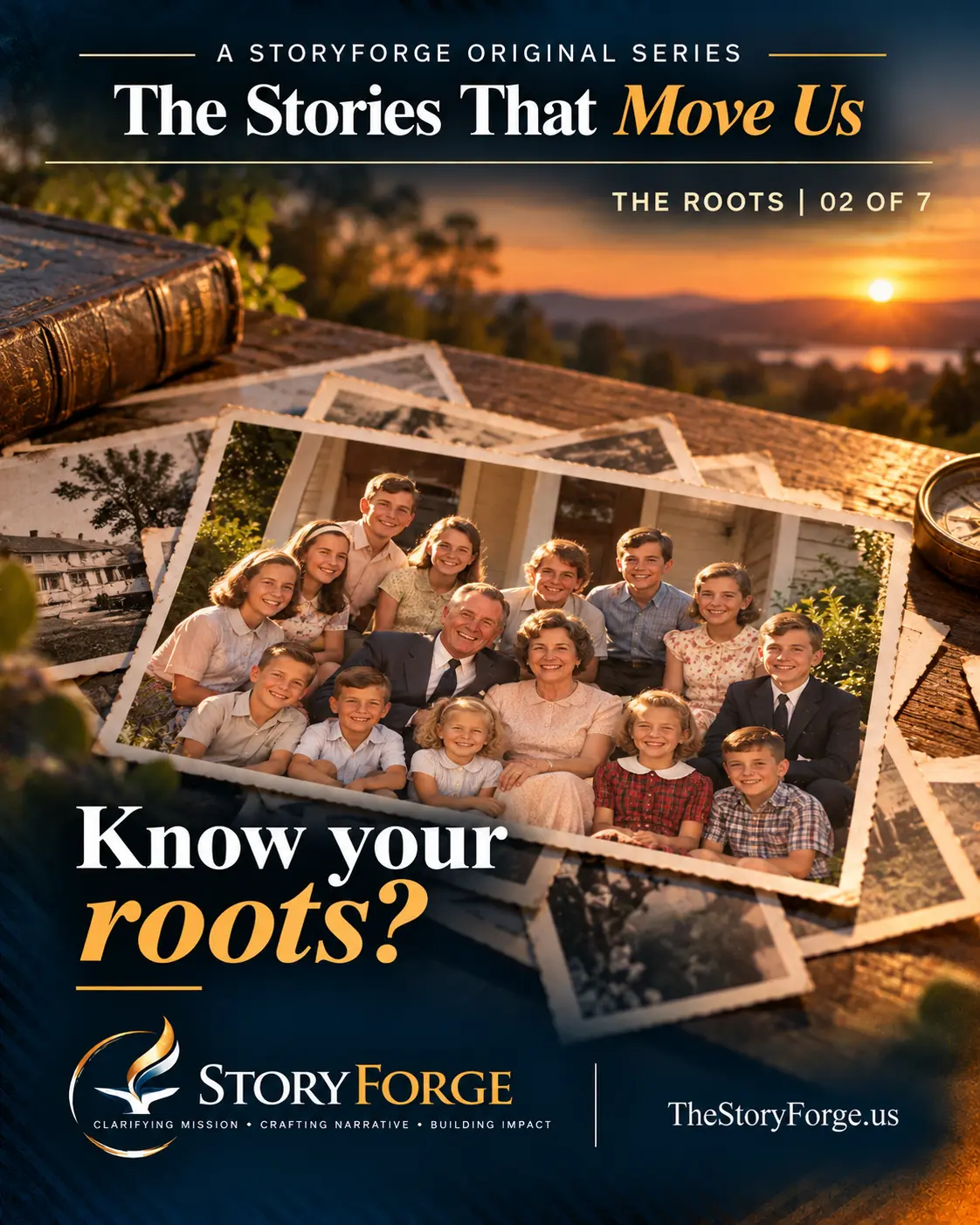
Years ago, one of my first significant projects in full-time media production was creating a film biography of Jim and Eileen Cullen.
Jim had grown up near Detroit during the rise of America's automotive industry. He served in Europe during World War II, returned home, married Eileen, and together they raised twelve children.
Think about the history contained in those two lives.
The Great Depression. World War II. The transformation of American industry. Marriage, sacrifice, uncertainty, perseverance, and the raising of a remarkable family.
A century of history, experienced not as headlines, but as life.
We captured their memories, their faces, their voices, their humor, and the hard-won wisdom of a lifetime.
Toward the conclusion, we asked what they most wanted their children and grandchildren to know.
It's a question that cuts through an extraordinary amount of clutter.
Because beneath all the things we accumulate and accomplish lies something far more foundational.
Where did we come from? What made us who we are? And what is worth carrying forward?
I think about the generations whose sacrifices made my own life possible. The convictions that sustained them. The challenges they overcame. The choices that shaped opportunities they would never personally enjoy.
How much of that inheritance do we actually know?
And how much disappears because nobody thought to ask?
I've come to recognize the same challenge in organizations.
A school may possess an extraordinary founding vision that few current families understand.
A nonprofit may have decades of sacrifice behind its mission, yet communicate primarily through programs and fundraising appeals.
A business may have something profoundly distinctive in its history and culture, yet describe itself in language interchangeable with a hundred competitors.
When we lose touch with our roots, we risk mistaking what we do for who we are.
And that's not merely a problem of storytelling.
It's a problem of direction.
Roots aren't anchors holding us in the past. They're what allow us to grow into the future.
Consider a tree.
The deeper and healthier its roots, the more confidently it can reach beyond itself. Its branches may extend in directions its earliest growth never anticipated, but they remain nourished by something essential.
So it is with families, communities, and organizations.
Knowing our story doesn't mean being confined by it.
It means understanding what we've inherited, what makes us distinctive, and what we're responsible for carrying forward.
Jim and Eileen Cullen gave their descendants more than a record of two remarkable lives.
They gave them a way to recognize themselves within a larger story.
Before asking where we're going, perhaps we ought to ask whether we truly know where we came from.
Because the future becomes richer when we know what we're carrying forward.
Greg Schlueter | Founder, StoryForge
Your organization is meant to go further.